
Twin Screw vs Single Screw Extruder: Which One Is Right for Your Plastic Production?
If you’ve been sourcing plastic extrusion equipment for a while, you’ve probably come across the same question again and again:
Should I choose a twin screw extruder or a single screw extruder?
It sounds like a simple comparison, but in real production, this decision can directly affect your product quality, material cost, and long-term maintenance.
I’ve worked with buyers from Eastern Europe, the Middle East, and South America, and one thing is clear — choosing the wrong type of extruder usually doesn’t show problems at the beginning. It shows up later, when production becomes unstable or material costs start rising.
Let’s break it down in a practical way.
What Is a Single Screw Extruder?
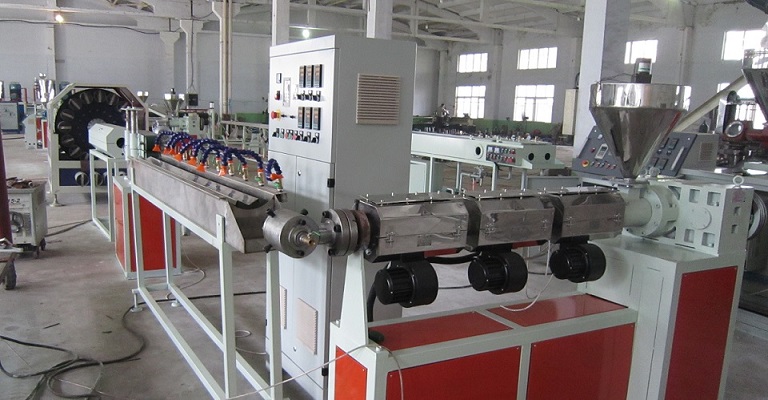
A single screw extruder is the most common and widely used type in plastic processing.
It uses one rotating screw to melt and push plastic material forward. The structure is simple, stable, and easy to maintain.
In most factories, you’ll see single screw machines used for:
HDPE / PVC pipe extrusion
Plastic sheet and film production
Profile extrusion with stable raw materials
If your material is relatively clean and consistent, a single screw extruder is often enough.
What Is a Twin Screw Extruder?
A twin screw extruder uses two intermeshing screws that rotate either in the same direction (co-rotating) or opposite directions.
Compared to single screw machines, the mixing ability is much stronger. That’s why it’s widely used for:
Compounding and material modification
Recycling plastics with impurities
Adding fillers, color masterbatch, or additives
Engineering plastics production
In simple terms, if your material is “complicated,” you’ll probably need a twin screw extruder.
Twin Screw vs Single Screw Extruder: Key Differences
1. Mixing Capability
This is the biggest difference.
A single screw extruder mainly melts and transports material.
A twin screw extruder actively mixes and disperses it.
If you’re working with recycled plastic or adding fillers, single screw machines often struggle to maintain consistency.
2. Material Flexibility
Single screw extruders work best with stable, uniform raw materials.
Twin screw extruders handle:
Recycled plastics
Mixed materials
High filler content
That’s why many recycling lines are built around twin screw systems.
3. Output Stability
This is something many buyers underestimate.
Single screw machines can produce very stable output — but only when the raw material is stable.
Twin screw machines are more forgiving. Even if your material quality fluctuates, the machine can still maintain relatively consistent output.
4. Cost and Investment
Let’s be honest — this is where many decisions are made.
Single screw extruder → lower initial cost, lower maintenance
Twin screw extruder → higher cost, but more capability
If your production is simple, going for a twin screw machine might be overkill.
But if your process involves compounding or recycling, choosing a single screw machine to save money often becomes expensive later.
5. Maintenance and Operation
Single screw extruders are easier to operate and maintain.
Twin screw extruders require more technical understanding, especially when it comes to screw configuration.
However, experienced operators can fine-tune twin screw machines for much better performance.
Which One Should You Choose?
Instead of asking “which one is better,” a better question is:
What are you producing, and what material are you using?
You can use this simple guideline:
Stable raw material + standard products → Single screw extruder
Recycling / compounding / complex formulations → Twin screw extruder
If you're planning long-term production with changing materials, investing in a twin screw system usually makes more sense.
A Common Mistake Buyers Make
Many buyers focus too much on machine price at the beginning.
I’ve seen cases where a factory bought a cheaper single screw extruder, but later had to:
Add extra mixing equipment
Deal with unstable product quality
Increase material waste
In the end, the total cost was higher than buying the right machine from the start.
Final Thoughts
Choosing between a twin screw vs single screw extruder is not just a technical decision — it’s a business decision.
The right machine helps you control quality, reduce waste, and stay competitive in your market.
If you're not sure which one fits your production, it’s always better to discuss your material, output requirement, and final product in detail before making a decision.
 Twin Screw vs Single Screw Ext
 How Much Does a PET Sheet Extr
 PET vs PP Sheet Extrusion Line