When customers contact us about sheet extrusion lines, one question comes up again and again: Should we invest in PET or PP?
At first glance, both materials seem similar. Both are widely used, both can be processed on sheet extrusion lines, and both are common in packaging and industrial applications. But from a manufacturing point of view, they are two very different directions.
Over the years, we’ve built and exported both PET and PP sheet extrusion lines to different markets. The decision is rarely about which material is “better.” It’s about which one fits your market, your raw material access, and your long-term business plan.
Market demand shapes the decision
In recent years, PET sheet has seen strong demand in food packaging, especially for thermoforming products like cups, trays, and containers. Transparency, recyclability, and its suitability for high-speed forming make it a preferred choice in many regions.
PP sheet, on the other hand, is often chosen for applications where heat resistance and cost control are more important. It’s widely used in food containers, industrial packaging, and stationery products.
From what we see in export markets, PET tends to be more attractive for businesses targeting higher-end packaging or export-oriented production. PP is often more stable in price-sensitive markets or for products with simpler requirements.
Material behavior in production
From a machine builder’s perspective, PET is more demanding.
PET requires stricter temperature control and more precise processing conditions. If the system is not well designed, issues like crystallization, bubbles, or loss of transparency can appear quickly. This is especially true when recycled PET is used.
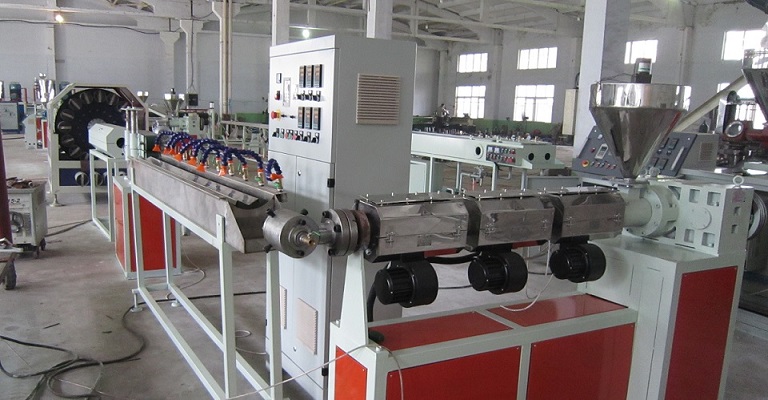
Because of this, PET sheet extrusion lines are usually equipped with stronger plasticizing systems, often using twin screw extruders or specially designed single screw systems with degassing.
PP, by comparison, is more forgiving. It melts and flows more easily, and the processing window is wider. For many factories, this means easier startup, fewer adjustments, and less dependence on highly experienced operators.
This difference in material behavior is one of the main reasons why PET lines are generally more complex and more expensive.
Investment and operating cost
The initial investment for a PET sheet extrusion line is typically higher.
This comes from the need for better components, more precise control systems, and additional features like vacuum degassing or advanced filtration. If the project includes recycled PET, the cost can increase further.
PP sheet extrusion lines are usually more straightforward in design, which keeps the investment lower.
However, cost should not be evaluated only at the purchasing stage.
In actual production, PET products often have higher added value, especially in packaging industries where appearance and clarity matter. Many of our customers recover their investment through higher margins, even though the initial cost is higher.
PP, on the other hand, can offer more stable and predictable production with lower technical risk, which is valuable for factories focusing on volume and cost efficiency.
Production stability and operator requirements
Another difference we often discuss with customers is operation.
PET extrusion requires tighter control. Small fluctuations in temperature or material condition can affect the final product. This means operators need a certain level of experience, especially in the early stages of production.
PP extrusion is generally easier to manage. For factories that are new to sheet extrusion or have limited technical staff, this can make a noticeable difference.
In some projects, customers initially plan for PET but later switch to PP after considering their team’s experience and production environment.
Flexibility and future expansion
Some buyers also think about long-term flexibility.
PET lines can sometimes be adapted for different grades or recycled materials, depending on the configuration. This can be an advantage in markets where sustainability and recycling are becoming more important.
PP lines, while simpler, are usually more focused on specific applications. They are reliable and efficient, but less flexible when it comes to handling more complex material variations.
From our experience, customers who have a clear long-term product strategy tend to make better investment decisions.
So, which one should you choose?
There is no universal answer.
If your target market is food packaging with high transparency requirements, and you are prepared for a more complex production process, PET is often the right direction.
If your focus is on stable production, lower investment, and easier operation, PP may be a more practical choice.
From a Chinese factory perspective, both options are mature. The key is not the machine itself, but how well it matches your business model.
Final thoughts
We’ve seen successful projects on both sides—PET and PP.
The difference usually comes down to preparation. Buyers who understand their market, their material, and their production capabilities tend to make the right choice, regardless of which material they select.
An extrusion line is a long-term investment. Taking the time to align your decision with real production conditions will always pay off.
FAQ
1. Is PET sheet extrusion more profitable than PP?
It can be, especially in high-end packaging markets, but it also comes with higher investment and stricter production requirements.
2. Why is PET extrusion more complex than PP?
PET requires precise temperature control and is more sensitive to processing conditions, especially when recycled material is used.
3. Can one extrusion line produce both PET and PP sheets?
In most cases, no. The processing requirements are different, and each material typically needs a dedicated configuration.
4. Which is better for beginners: PET or PP sheet extrusion?
PP is generally easier to operate and more forgiving, making it more suitable for first-time projects.
5. How do I decide based on my market?
Look at your target products and customers. If transparency and packaging quality are critical, PET may be the better choice. If cost and stability are priorities, PP is often more suitable.

 Twin Screw vs Single Screw Ext
 How Much Does a PET Sheet Extr
 PET vs PP Sheet Extrusion Line